
Competency Management System: Why Internal Standards and Industry Benchmarks Belong in One View

Whew, a workforce can meet every internal competency requirement and still lack context about how its capability compares.
That is why a competency management system should bring two distinct views together: your company’s own standards and anonymized industry benchmarks.
They answer different questions.
Internal standards show what your organization requires for its roles, procedures, and operations.
Industry benchmarks add outside context by showing how assessment results compare with relevant peer, industry, or regional data.
When the two are clearly distinguished in one system, leaders can see where people stand, understand what a gap means, and decide what to do next.
Internal standards define what your operation needs
Your internal competency standard is your organization’s definition of readiness.
It reflects the requirements of your roles, operating environment, procedures, equipment, and risk priorities.
For one role, the standard might require a specific technical skill at a defined level.
For another, it might include a site-specific procedure or an additional qualification.
These requirements belong to your organization, even when you use industry frameworks or external references to help shape them.
That distinction matters because a worker can compare favorably with peers and still fall short of a requirement that is essential to your operation.
A benchmark cannot decide whether someone is qualified for your company’s work.
Your organization sets that standard.
Industry benchmarks add context, not a replacement standard
An industry benchmark adds a point of comparison beyond your company’s own results.
iCAN’s Competency Management System combines real-time internal assessments with crowdsourced, anonymized industry assessment data.
Organizations can compare workforce competency with available benchmarks from peers, industry leaders, or regional averages.
This outside view can reveal patterns that internal reporting alone may not make clear.
A team might meet its internal target, for example, while its assessment results still point to an opportunity to improve.
Or an internal gap might remain important even when the team compares well with industry data.
The benchmark helps answer, “How do our results compare?” It does not replace the question, “Does our workforce meet our requirements?”
Keeping the answers separate avoids two mistakes: assuming internal compliance proves market-level strength, or chasing an external comparison that does not fit the work your organization needs done.
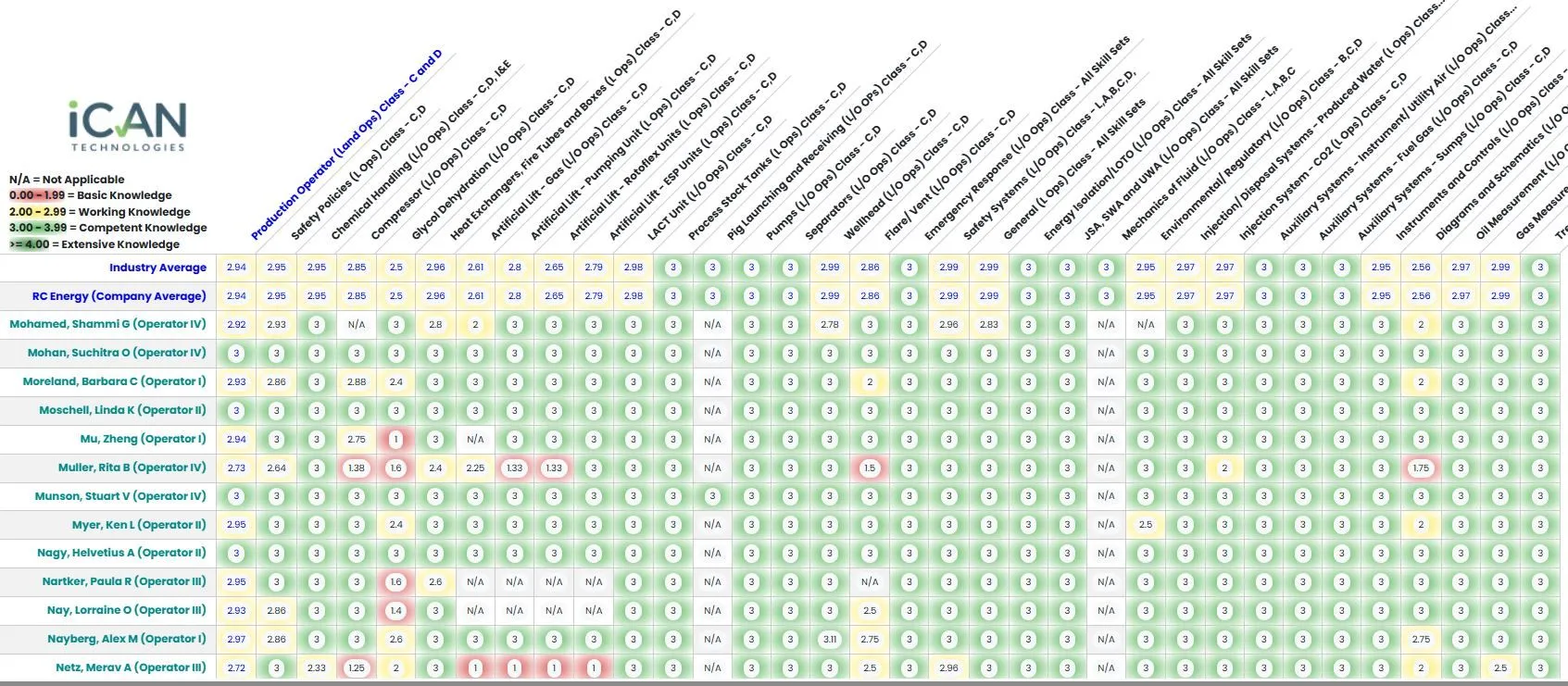
One view, two clearly labeled comparisons
The value of a combined competency management system is not simply putting more numbers on a dashboard.
It is making clear which reference point each result uses.
A useful view distinguishes the company standard from the industry benchmark, then helps leaders interpret the relationship between them.
Consider four common patterns:
- Below the internal standard and below the benchmark: The gap may call for targeted development, reassessment, or another workforce action.
- Below the internal standard but at or above the benchmark: The company requirement still applies, even if outside comparison looks favorable.
- At or above the internal standard but below the benchmark: Leaders may want to review the result and decide whether the internal standard or development approach needs attention.
- At or above both: The organization can recognize a strength and consider how to maintain it.
These patterns are starting points for informed review, not automatic decisions about an employee.
The system should preserve the meaning of each comparison so managers can use judgment and account for operational context.
Move from a visible gap to a specific action
Competency information becomes more useful when leaders can see more than a score.
A practical gap-to-action view helps answer: which skill is missing, who is affected, how serious the gap is, and which procedure or task it affects.
It should also make the next step clear, whether that means assigning development, completing an assessment, or reverifying competency.
With real-time competency tracking and live heatmaps, iCAN can show workforce readiness by department, location, or role, with visibility across thousands of employees.
That helps teams see whether a concern affects one employee, a group, or a wider part of the operation.
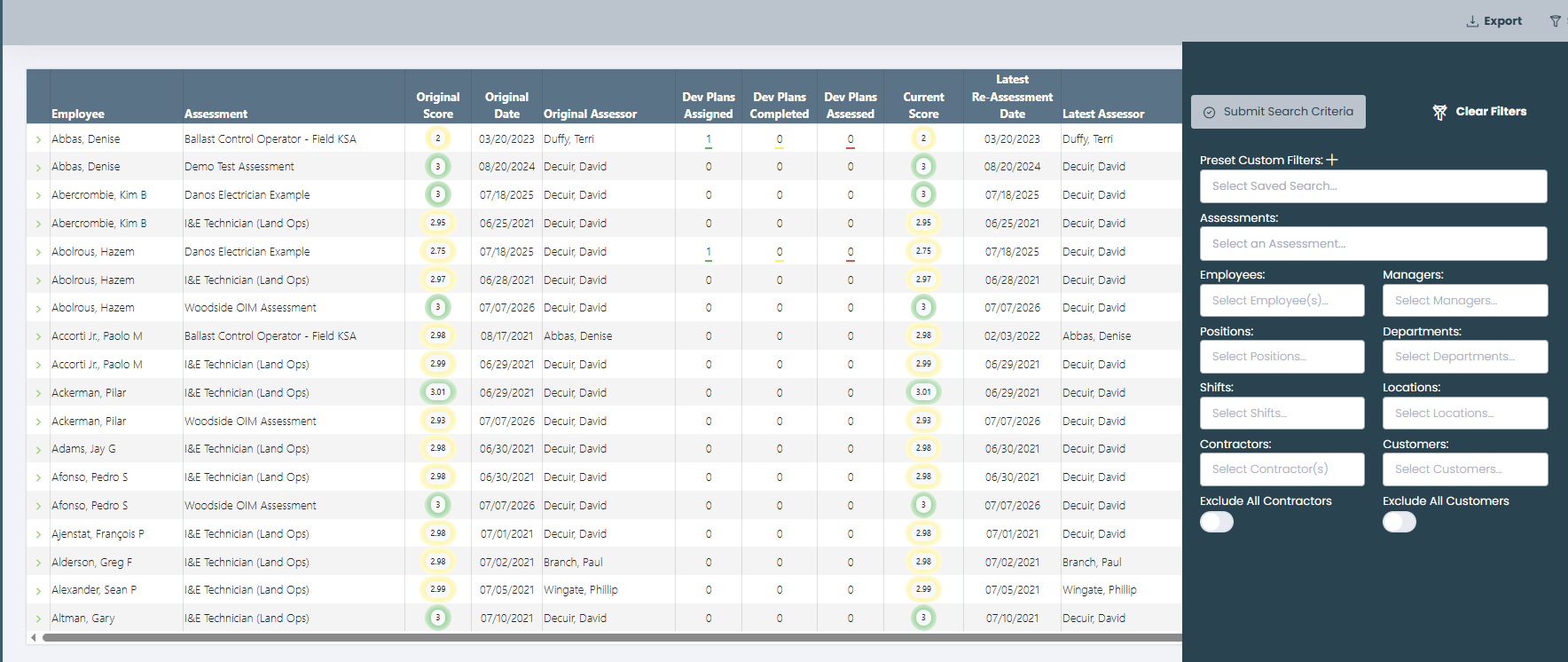
A connected record also helps explain how a result was reached.
iCAN links the evidence chain from requirement → source content → training → assessment → result → development action.
That makes it easier to understand what was expected, what learning or assessment took place, what the employee demonstrated, and what happened next.
When competency requirements or procedures change, organizations can also reverify competency throughout the employee lifecycle, including onboarding, role changes, and upskilling.
The result is a view of progress over time, not just a record of a past course or assessment.
Protect confidentiality while adding industry perspective
Industry benchmarking needs to provide useful context without exposing an individual organization’s assessment records.
iCAN uses anonymized competency data for industry benchmarking, while customers retain ownership of their data.
Individual customer assessment records are not shared with other organizations.
This separation matters to leaders who want an external reference while maintaining control of their own workforce information.
It also helps clarify what the benchmark represents: anonymized assessment results used to provide industry comparison, rather than another company’s identifiable employee data.
Learn more about iCAN’s industry benchmarking and how it adds context to workforce assessment results.
What this can look like in practice
A published case study for a Gulf of America operator shows how competency data can guide focused workforce development.
More than 19,000 annual training hours were realigned to verified competency gaps.
A targeted Glycol Dehydration gap-closure program delivered 528 in-person training hours and 1,060 computer-based training hours, followed by a 5% increase in post-assessment scores.
The published results also reported a BSEE inspection INC-to-component ratio 50% below the industry average, a TRIR of 0.36, and a SIF rate of 0.04, the lowest incident rates in the company’s history.
These figures illustrate the importance of connecting assessment results to targeted action and follow-up measurement.
They do not mean a benchmark alone determines which training to assign or guarantees a specific outcome.
The organization still needs to understand its own requirements, identify its gaps, and choose the right response.
Read more on the iCAN case studies page.
What to look for in competency management software
When evaluating competency management software, ask whether it can show both your internal requirements and the industry comparison without blending them together.
Look for a clear distinction between company standards and benchmark data, real-time views of competency across roles and locations, and a path from identified gaps to development and reassessment.
Traceable evidence matters, too.
Leaders should be able to understand the requirement, supporting content, training, assessment, result, and development action associated with a competency.
The goal is not to collect more scores.
It is to know what those scores mean for your organization, where workforce capability needs attention, and whether follow-up action improved the result.
Explore the iCAN Competency Management System to see how internal assessments, workforce views, development actions, and industry benchmarks fit together.
Frequently Asked Questions
What is a competency management system?
A competency management system tracks the skills and proficiency required for work, assesses workforce capability against those requirements, and helps organizations identify and address competency gaps.
What is the difference between internal standards and industry benchmarks?
Internal standards define the competency levels an organization requires for its roles and operations, while industry benchmarks compare assessment results with available anonymized data from other organizations.
Can industry benchmarking replace our company’s competency requirements?
No. Industry benchmarking adds external context, but each organization remains responsible for defining and applying its own role, task, and operational requirements.
How does a competency management system support audits?
A competency management system can connect each requirement to its source content, training, assessment, result, and development action, helping teams trace the evidence behind competency decisions.
How is competency data kept confidential in industry benchmarking?
iCAN uses anonymized competency assessment data for industry benchmarking, and customers retain ownership of their data; individual customer assessment records are not shared with other organizations.
How can we see whether development improved competency?
Organizations can use reassessment to verify competency after development and track results over time, including through onboarding, role changes, and upskilling.
Book a demo to see how internal standards and industry benchmarks can work together in one competency management system.