
One Skills Matrix Across Every Site: Standardizing Competency Data in Multi-Asset Operations

Whew, keeping competency standards consistent across multiple sites is harder than it sounds.
Different assets use different procedures, equipment, job titles, and training records, making it difficult to tell whether two employees with the same role are equally ready for the work.
A shared spreadsheet can make information easier to find, but it cannot create a shared standard by itself.
Multi-asset operations need one trusted competency framework that preserves enterprise-wide consistency while accounting for local requirements.
Why multi-site skills data becomes inconsistent
Competency information often grows site by site.
One location may record a qualification as complete, while another requires an assessment or supervisor verification before marking the same skill as demonstrated.
Job titles can vary, too, even when employees perform similar tasks.
Over time, teams create different labels, proficiency scales, and review schedules, so leaders cannot confidently compare readiness across assets.
That creates more than a reporting problem.
When training records show hours or course completion but not demonstrated capability, important gaps can stay hidden until a task, audit, or operational change brings them to light.
Build one standard with room for local context
A useful multi-site skills matrix starts with common definitions, not a list of every employee and course.
For each competency, define what the skill means, which roles need it, what level is required, how someone demonstrates it, and when that evidence needs reassessment.
A useful reference point is ISO/TS 17969, which addresses competency profiles, proficiency levels, assessment, and competency records for oil and gas operations.
The goal is not to make every site identical.
It is to create an enterprise baseline, then add controlled requirements for specific assets, equipment, procedures, regulations, or operating conditions.
Separate common requirements from site-specific ones
A practical framework can group requirements into three layers:
- Core competencies: Shared requirements, such as applicable HSE competencies across disciplines.
- Role-specific competencies: Skills tied to a job title, task, and required proficiency.
- Site or asset requirements: Local qualifications, equipment knowledge, and procedure-specific expectations.
This structure helps leaders distinguish a common qualification from a local add-on without losing either one.
It also makes the matrix easier to maintain when a procedure changes or a site introduces new equipment.
Standardize what a competency status means
Consistent labels make a matrix easier to interpret, but each label needs a shared definition.
For example, a competency management system may distinguish between:
- Competent: Evidence supports the required level.
- Needs development: An assessment identifies a gap to address.
- Not yet verified: The competency has not been confirmed with evidence.
- Expired due for reassessment: Previous evidence needs review or renewal.
These distinctions matter across sites.
“Not yet verified” should not be confused with “not competent,” and an expired record should not be treated as current simply because the employee completed training in the past.
A shared status model gives managers a consistent way to review competency data and decide what action comes next.
Connect each record to evidence and action
A useful skills matrix software solution should help teams move from a status to its supporting record.
That record may connect the employee and role to the relevant requirement, assessment result, assessor, supporting evidence, and reassessment date.
When the matrix points to evidence, managers can better understand how a qualification was established instead of relying on a color-coded cell with no context.
It also becomes easier to follow development needs through to completion.
Teams can see which requirements need training, which need a practical assessment, and which need reassessment before an employee returns to a task.
Explore iCAN’s competency management system to see how individual competency, workforce-level gaps, and development actions can be connected.
Make gaps visible at the right level
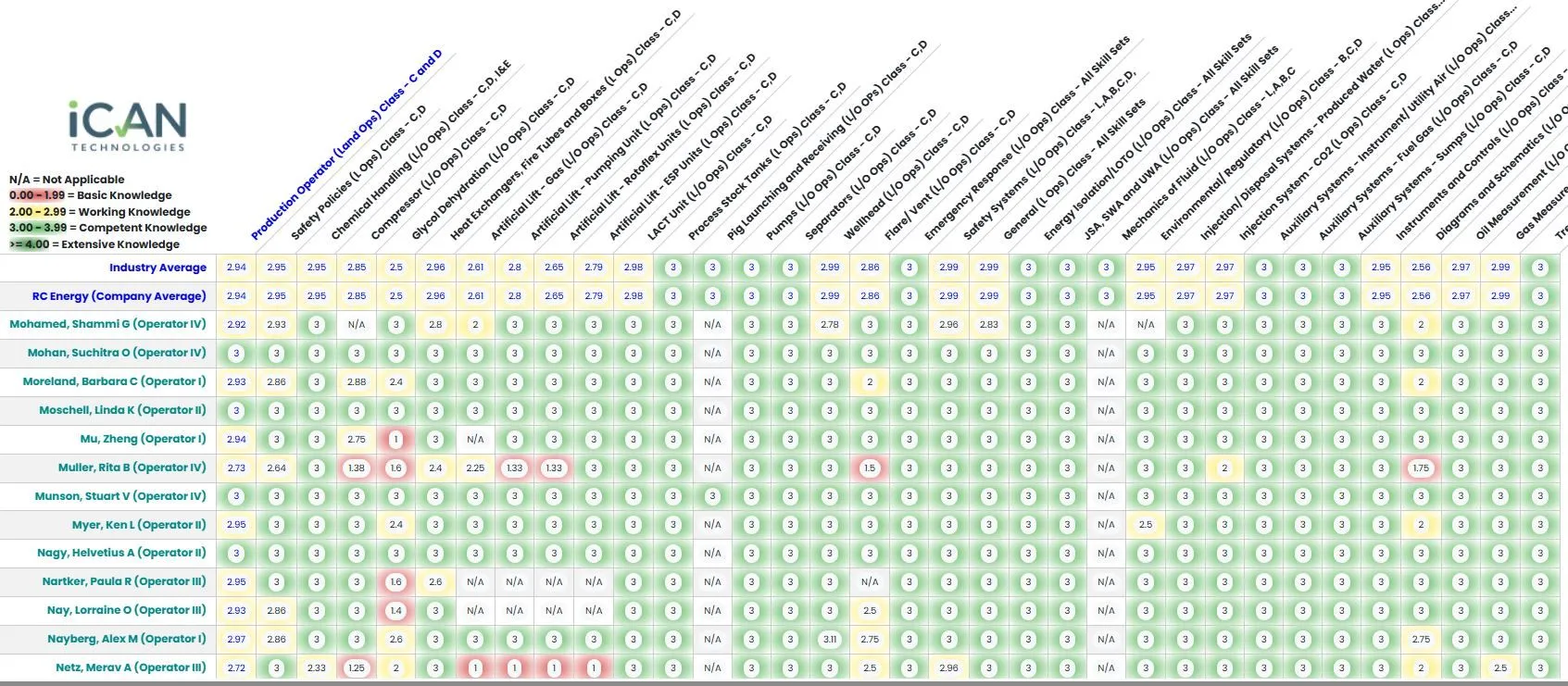
A heat map can reveal patterns that are easy to miss in individual employee files.
Leaders can review competency by role, asset, or site to spot where a critical skill is concentrated in only a few people, where a team needs development, or where a qualification is due for reassessment.
That visibility supports better planning.
A supervisor can focus on the skills needed for a specific assignment, while a training leader can identify recurring gaps across sites and prioritize development accordingly.

Use industry benchmarking as context, not a replacement standard
Internal requirements tell an organization whether its workforce meets its own expectations.
Industry benchmarking can add another point of reference by comparing assessment results with available anonymized data from regulated technical workforces.
That comparison can help leaders notice development opportunities that internal reporting alone may not reveal.
It does not replace an organization’s requirements, local risk assessment, or qualification decisions.
iCAN’s benchmarking draws on aggregated and anonymized assessment data, with no invented benchmark figures needed to make the comparison useful.
Learn more about industry benchmarking and how it can add context to workforce assessment results.
Connect competency data to training and compliance
Competency records and training records answer related but different questions.
A learning management system can show who has been assigned training, who completed it, and which certifications are approaching expiry.
Competency evidence helps show what an employee has demonstrated.
Connecting the two gives managers a clearer picture of what was required, what learning took place, how performance was assessed, and what action followed.
For operations looking for an LMS for utilities, LMS for manufacturing, or a frontline LMS, the connection matters across online learning, classroom instruction, and on-the-job verification.
A unified system can support assignments, expiration alerts, real-time compliance status, and audit trails alongside competency information.
That reduces the need to reconstruct an employee’s record from disconnected spreadsheets, training files, and assessment forms.
Learn how iCAN supports learning and compliance tracking.
What a multi-asset competency program can improve
One major Gulf of America offshore operator needed to establish consistent competency standards across roles, assets, and locations after integrating different operational cultures.
Its earlier systems tracked training hours, but did not provide a consistent view of demonstrated capability.
The operator introduced a structured framework with core HSE competencies across disciplines and technical competencies tied to job titles and skill levels.
A targeted Glycol Dehydration gap-closure program delivered a 5% increase in post-assessment scores, and more than 19,000 annual training hours were realigned to verified competency gaps.
Those results show the value of connecting development effort to identified needs rather than treating training volume as a measure of readiness.
Read more through iCAN’s case study resources.
A practical rollout for multiple sites
A thoughtful rollout does not require every location to rebuild its records at once.
Start by agreeing on the enterprise competency definitions, proficiency expectations, evidence rules, and status labels.
Then map existing site and role requirements to that shared structure, marking local additions clearly.
Pilot the framework in locations with different assets or operating conditions, and ask supervisors and assessors whether the definitions work in day-to-day decisions.
Finally, establish ownership for updates, reassessments, and data quality so the matrix stays useful as roles, procedures, and equipment change.
The objective is not simply one database.
It is one dependable way to understand competency across the operation.
Frequently asked questions
What is a skills matrix for multi-asset operations?
A skills matrix for multi-asset operations organizes required and demonstrated competencies by employee, role, site, and asset so leaders can review capability consistently across locations.
How can organizations standardize competency data across sites?
Organizations can standardize competency data by defining shared competency descriptions, proficiency levels, evidence requirements, and status labels, while managing site-specific requirements as controlled additions.
What is the difference between training completion and competency verification?
Training completion records show that an employee finished assigned learning, while competency verification records show whether the employee demonstrated a required skill through defined evidence or assessment.
How does a competency management system help multi-site teams?
A competency management system helps multi-site teams connect role requirements, employee assessment results, development needs, and supporting evidence in a shared view of workforce capability.
Can one skills matrix support both utilities and manufacturing?
Yes, one skills matrix framework can support utilities and manufacturing by using common competency definitions where appropriate and adding controlled requirements for each role, site, asset, and operating context.
Build a clearer view across every site
One standard does not mean every location does the same work.
It means leaders can understand what competency means, what evidence supports it, and where development needs attention, across the operation.
Request a demo to see how iCAN can connect competency management, training records, and workforce insight across your sites.